
 by
by It saddens me that student speech rights have been continuously curtailed in the decades since I was in school. I become even more depressed when teenagers accept such indignities without making any attempts to circumvent them. Nationally recognized examples of student journalism, as in the case where Stanford freshman Theo Baker brought about the resignation of Stanford University’s President and the Cornell campus rape investigations are reasons to celebrate righteous student ingenuity.
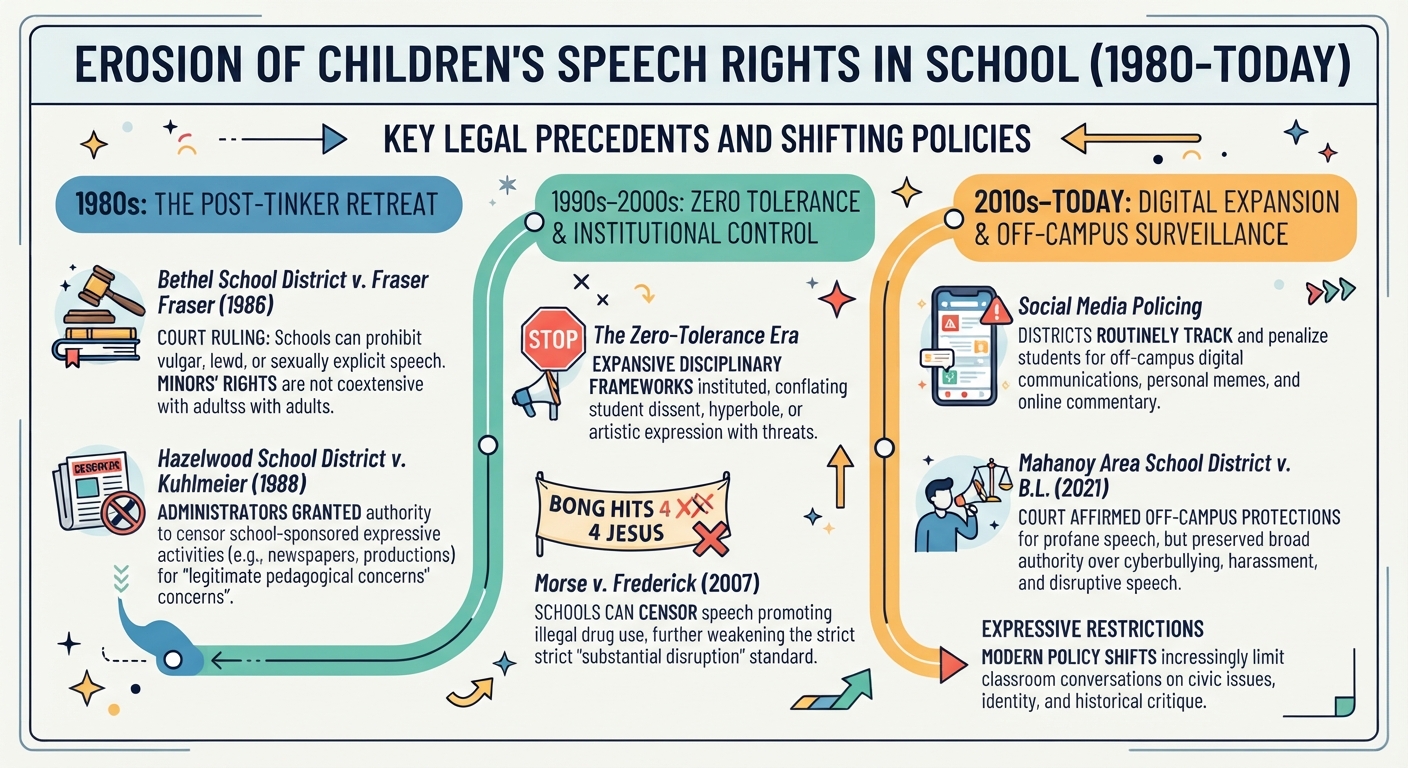
While in seventh grade, I worked on the official school newspaper. A friend of mine and I also published an unofficial “underground” student newspaper in which we made fun of things. My budding career as a swashbuckling journalist came to an abrupt end when the faculty advisor of the “official” school newspaper followed me into the boys’ room, tossed me up against a stall, and warned that he would kill me if we published another issue. Back then, you needed access to a printing press to commit satirical mischief. Today, every kid has a TV studio, radio broadcaster, and printing press in their pocket. It is for these reasons that I am delighted to encounter tales of “kids” getting into good trouble.
A recent episode of the mighty Ira Glass’ spectacular radio show, This American Life, solves a fascinating mystery that leads to the discovery of ingenious “tiny hackers.” I don’t want to spoil the spectacular storytelling. So listen to the full story here. “Watch” it on YouTube, or just click on the trailer above.
That reminds me
The story told on This American Life is reminiscent of experiences I had with kids tiptoeing around the edges of the rules while behaving in a perfectly reasonable fashion.
Tale 1 — WWWadio
One of the first articles I wrote for Curriculum Administrator Magazine was WWWadio, back in December 1998. This led to a ten-year run as a contributing editor and senior editor for its successor, District Administration Magazine. The article chronicled some joyful work I did with students who demonstrated competence and good citizenship. This twenty-eight-year-old article describes working in a laptop school (1:1 environment), the timeless hysteria over network security, the trustworthiness of students, AND what today would be called podcasting, before podcasting was cool or even invented. In fact, few schools in the world were online at the time that these kids and I produced a digital radio show on the World Wide Web.
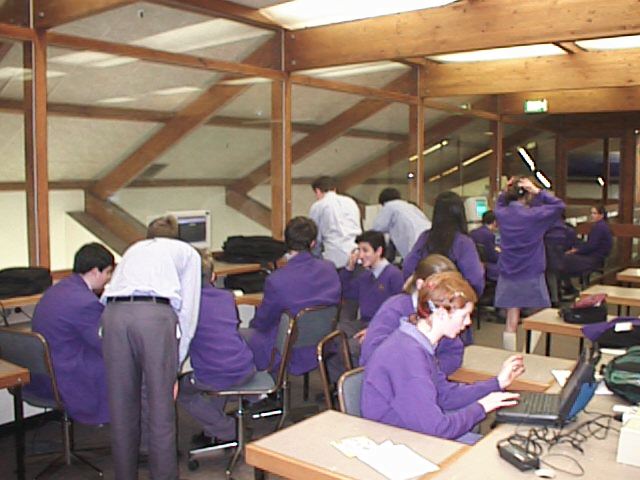
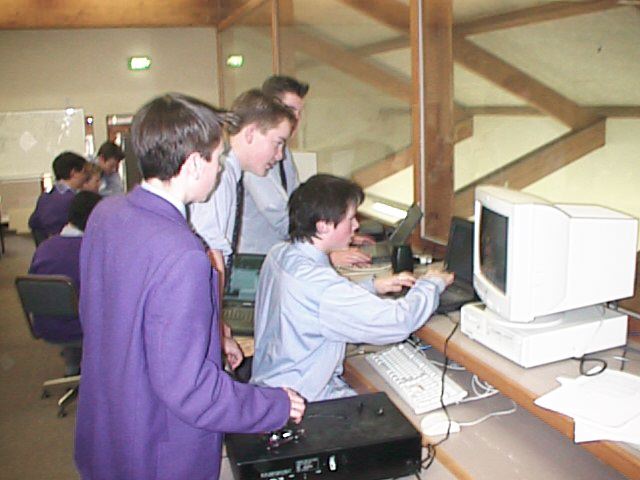
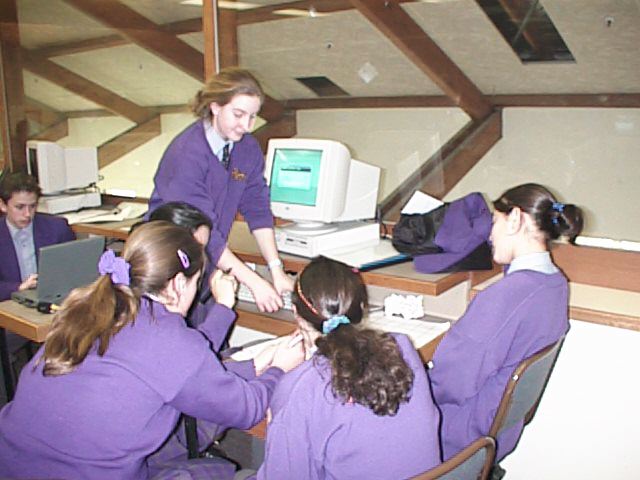
I had the good fortune of being in residence at Melbourne, Australia’s Wesley College, the largest independent school in the Southern Hemisphere, and one where I was in residence several times in the 1990s. One day, I was given a large class of 8th graders for the day and thought this was the perfect opportunity to learn together by making something. Those were the early days of streaming media and I had been observing the rise of platforms like RealAudio. That day, the students and I figured out the technical nuts and bolts of storing and playing web audio and produced a “radio show” we called, WWWadio. (clever, eh?)
To simplify matters, I gave the kids the username and password for the web server I used for my professional website. This was quicker, easier, and much more flexible than waiting the decade or two it would have taken to persuade the school IT department to share a few dozen kilobytes of server space. All of the students worked hard and the day was a success, especially because I understood streaming audio better myself as a result.
Fast forward a few years…
In 2009, I wrote the following about a discovery I made long after that daylong class at Wesley College.
For several years I traveled the world sharing the story of WWWadio as an example of how the computer can be used to enhance personal expression and offer a global audience. Another lesson had to do with network security and student trustworthiness.
ㅤI gave all of the students my personal server username and password without fear for the following reasons:
1. They needed server access in order to do their work.
2. I was too busy teaching to constantly be interrupted in order to type a password into student computers.
3. I believed that if I trusted the students with my Web server, they would behave responsibly. Besides, the server was backed-up in case something went wrong.
4. The kids were so busy that they were likely to forget my password.
5. It’s just a damned server.
ㅤI never bothered to change the server password following the WWWadio class. At presentations I proudly proclaimed how the students did not harm my server, despite having root access. This was a stunning dose of reality for educators fearful and suspicious of children.
ㅤThen it happened…
ㅤOne day, I found an unfamiliar folder residing on my Web server. Since I’m such a disorganized person, I just figured that I had accidentally created a folder or assumed that my service provider had placed it there.
Curious, I looked at the contents of that mystery folder through a Web browser. Surprise! The Australian private school students had been maintaining a school-related newspaper on my server somewhere in the United States for 2-3 years without my knowledge, and more importantly, without doing any damage to the server or any of its other contents.
ㅤThat’s right, despite the high tuition fees the students paid, the fact that every student has her own laptop AND the school’s millions of dollars’ worth of networking infrastructure and personnel, students found the school network unreliable or too difficult to use in a way that suited their needs.
ㅤIt sure is a shame how much time, money and personnel schools spend on computer networks only to complicate or cripple them.
Read the complete WWWadio story and my reflections on lessons learned over three decades here.
Tale 2 — Social Media Bans
I appreciate that most of the attacks on “screen time,” AI bans, cellphone confiscation, and age-gating social media come from a genuine desire to protect children. I also find such moral panics heavy-handed, ineffective, burdensome on teachers, ignorant of unintended consequences, shortsighted, and ultimately on the wrong side of history. I am an optimist and a partisan who stands on the side of children. I believe that the affordances of computational and communications technology far outweigh any potential downside.
So, when I began messing about with using AI chatbots to help me design software, I was thinking of Australia’s recent federal legislation making it illegal for children under 16 years-old to use “social media.” (I should say I was never a hype man for social media or agreed with the predictions that it would revolutionize education, although I use it myself.) I asked a chatbot a question along the lines of, “If I were a 15-year-old kid, what sort of social media networking software would I be capable of creating and deploying myself?” The response suggested that it was indeed possible, with the help of an AI apprentice, to create my own social network.
Knowing that Australia passed federal legislation banning kids under sixteen from social media, I asked the chatbot, “Would this run afoul of Australian law?” The answer was, no, because the hamfisted legislation names specific verboten platforms, not one created by a kid. Whether that interpretation would withstand legal scrutiny is another matter. 🤔
Fast forward a few days…
I was in residence in another fantastic Australian school and visited a high school classroom, where a student in tenth grade asked if I wanted to see the project he was working on. Of course I did.
He programmed his own social networking software.
The kids are alright!

Veteran educator Gary Stager, Ph.D. is the author of Twenty Things to Do with a Computer – Forward 50, co-author of Invent To Learn — Making, Tinkering, and Engineering in the Classroom, publisher at Constructing Modern Knowledge Press, and the founder of the Constructing Modern Knowledge summer institute. He led professional development in the world’s first 1:1 laptop schools thirty years ago and designed one of the oldest online graduate school programs. Gary is also the curator of The Seymour Papert archives at DailyPapert.com. Learn more about Gary here.