 by
School makerspaces are a miracle. They exist in both the most oppressive and progressive educational settings. Not only have makerspaces continued to be embraced by schools of all kinds and grade levels, but they outlast the typical new interventions that have a four- or five-year lifespan. Some makerspaces and Fab Labs are nearly twenty years old.
Thus far, (fingers crossed) makerspaces have escaped the attacks of the reactionary vulgarians demanding that screens be removed from classrooms. It seems that even the most anxious parents, politicians, and principals find value in learning-by-making, at least when found in the school makerspace. One school I know relocated the makerspace next to the front door so that prospective parents could always see creative children learning with their hands, hearts, and heads. It’s good for recruiting and public relations.
Making offers something for everyone. Parents like happy creative kids. Imaginative educators view making as a way of expanding the breadth, range, and complexity of possible projects. Cynical politicians find the gritty notion of learning with one’s hands, anti-intellectualism, and vocational preparation appealing. It’s a win-win-win.
Makerspaces may have been spared from the destructive forces of the eliminationists, since many offer the return of computer labs as a conciliatory gesture, as they return classrooms to their medieval pen and lecture splendor. Such concessions should be viewed as a pyrrhic victory.
To the enemies of progress, it is more acceptable to teach children about computers/AI/making than to grant agency over an increasingly complex and technologically sophisticated world. Personal computing must be out of reach to little people. Anytime, anywhere learning is a threat to those advancing pedagogical schemes based on every child being taught X in Y sequence at Z pace in preparation for a standardized test.
What separates 21st-century making from industrial arts — shop class, or arts and crafts — is computation. Computation is the secret sauce of making supercharging what kids can make and learn.
At the very least, maker educators can embrace computation for new project ideas and to supplement their curriculum. If we adopt Stephen Wolfram’s definition of computation as “organizing your thoughts clearly enough that you can explain them to a sufficiently smart computer,” then computation is essential for becoming a writer, mathematician, scientist, historian, and artist, in addition to being essential for making.
If the makerspace becomes the last bastion of creativity, then it falls upon maker educators to step on the gas as a matter of urgency. Computational making is that rocket fuel.
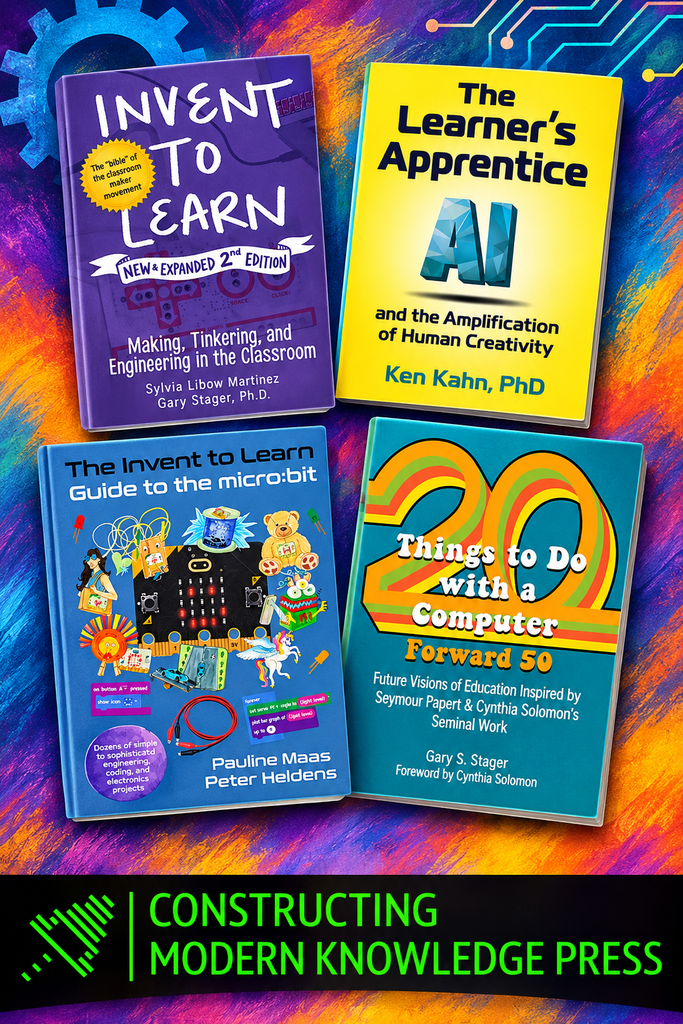
Invent To Learn, The Learner’s Apprentice, and Twenty Things to Do with a Computer: Forward 50, are but a few of our books celebrating computational making, an idea dating back six decades to Seymour Papert and colleagues’ efforts at the MIT Artificial Intelligence Laboratory, where the unofficial motto was, “Computers are for children.” We want child empowerment, project-based learning, making, and computation to permeate every corner of the school, every minute of the school day, but faced with creative extinction, we’ll settle for robust forward-thinking computation in the makerspace.
Computational making can enrich the makerspace and the makerspace may save educational computing!
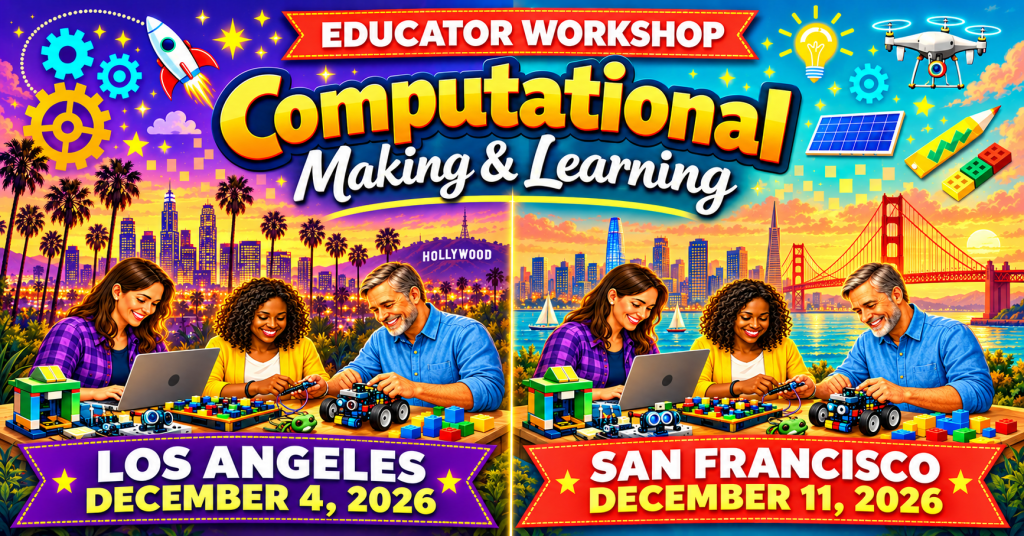
My upcoming Computational Making & Learning workshops in Los Angeles (December 4) and San Francisco (December 11) will help educators add computation to their bag of tricks, design microworlds to customize learning environments for specific learners – even young children, and use AI for mathematical experiments, data analysis, and game development. Learn more and register here.

Veteran educator Gary Stager, Ph.D. is the author of Twenty Things to Do with a Computer – Forward 50, co-author of Invent To Learn — Making, Tinkering, and Engineering in the Classroom, publisher at Constructing Modern Knowledge Press, and the founder of the Constructing Modern Knowledge summer institute. He led professional development in the world’s first 1:1 laptop schools thirty years ago and designed one of the oldest online graduate school programs. Gary is also the curator of The Seymour Papert archives at DailyPapert.com. Learn more about Gary here.