 by
by They’re dumb. They’re lazy. They’re sneaky. They’re gullible. They don’t read. They hallucinate. They’re mean. They’re dishonest. They can’t multiply. They’re addicted to social media…
Something must be done about the parents and politicians setting education policy today!
What’s that smell?
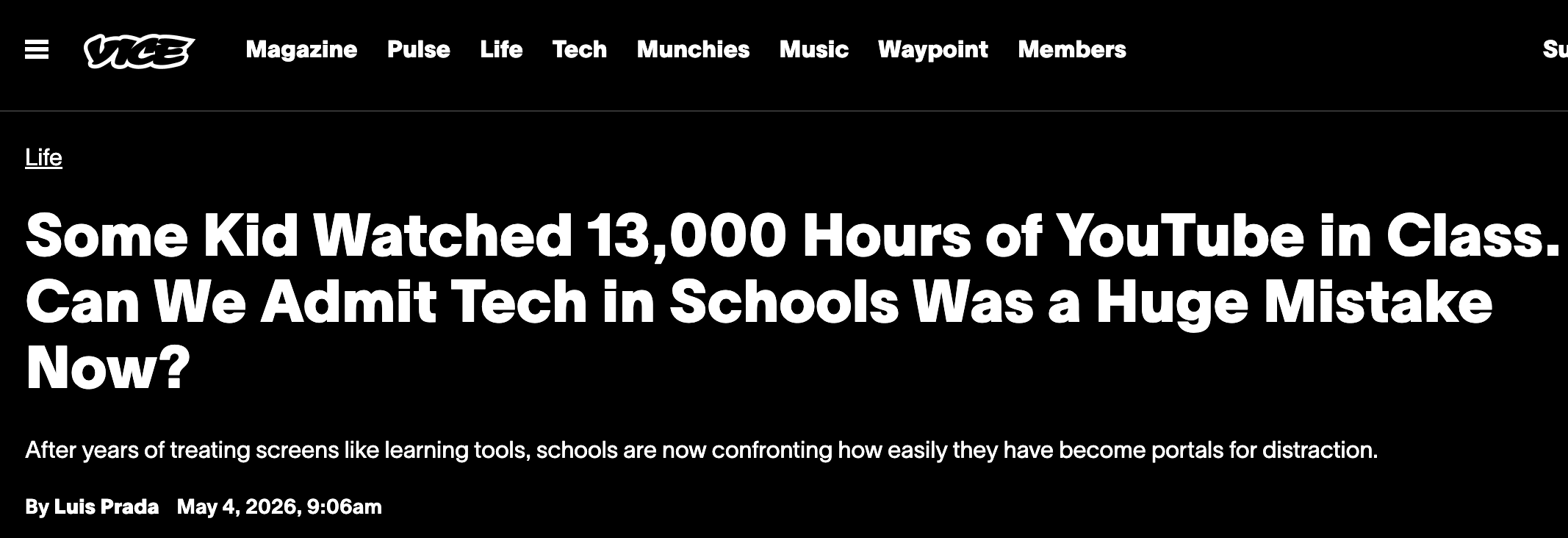
My social media feed runneth over with the hottakes of charlatans, doomsayers, and folks longing for the good ‘ol days that never existed. A common theme is disrespect for children masquerading as concern, often cloaked in terrifying data. For example, check out the headline (above).
That’s really terrible. If this monumental feat of reportage is even half true, any teacher involved should be severely disciplined. Classrooms should not be the site of senseless time wasting, even if teachers show seventh graders a few dozen Disney films each year.
Wowee! 13,000 hours of YouTube in class.
A mother in Wichita checked her seventh-grade son’s school Google account and found he had watched 13,000 YouTube videos over just a few months, and all during school hours… …Unfortunately, her story isn’t an outlier. It’s increasingly become the norm. The very same systems that keep you locked in and thoroughly distracted at home, on your couch, or on the subway, or wherever else, are doing the same thing for kids in school, in the classroom. — Vice (May 4, 2026)
Forget motive. Set aside conclusions or a call-to-action. Let’s just do some arithmetic.

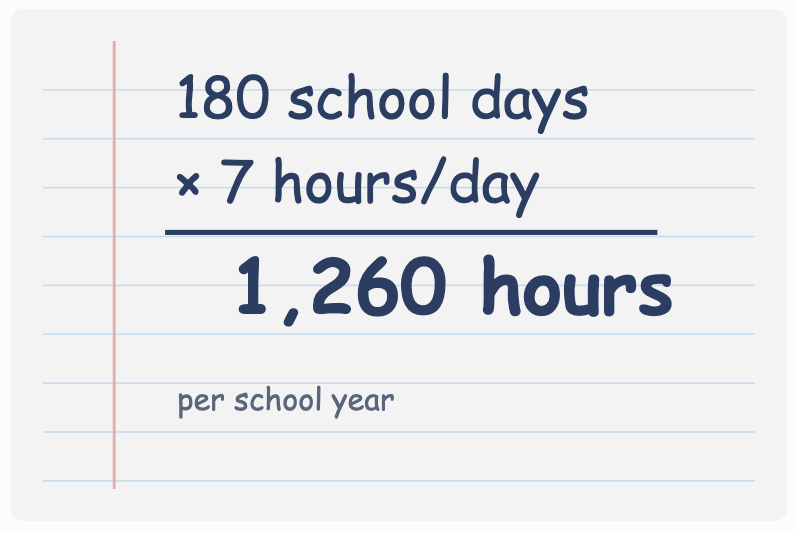
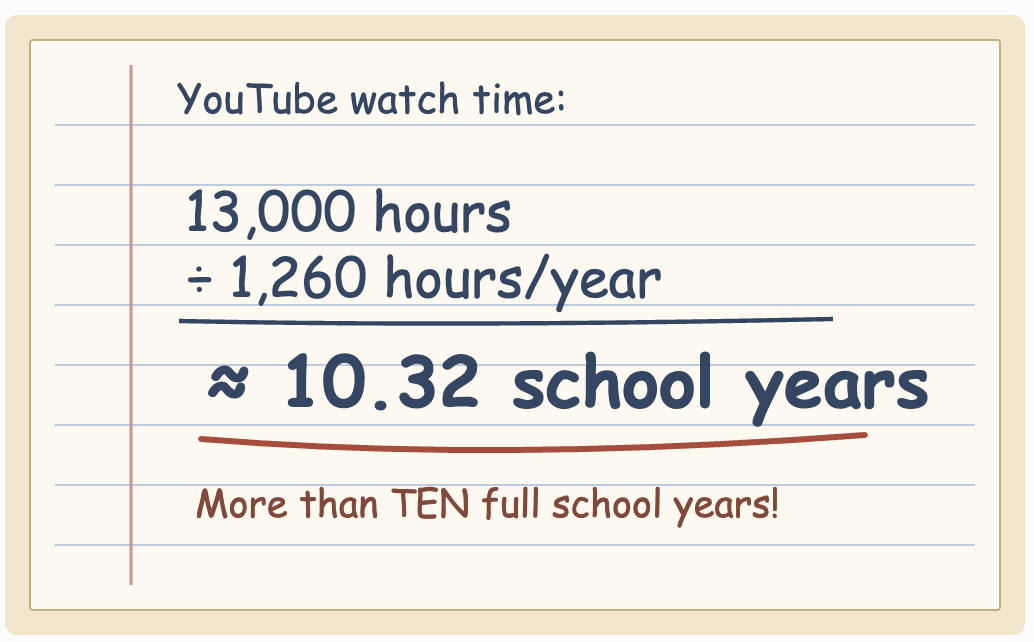
That kid from Wichita sure is gifted! He managed to watch 13,000 hours of YouTube videos in a school year that is only 10% as long.
If you read the quote in this groundbreaking piece of investigative journalism, the mother reported that her son watched 13,000 YouTube videos in class over just a few month period — still no small feat — but shouldn’t the indictment of our school system and educational computing be able to use a consistent unit of measure? Which is is it: hours or videos?
Mysterious strangers tell congressional committees that computers in classrooms are like anthrax. Digital worksheet czar Salman Khan disingenuously urges caution while schools are paying an “edurepreneur” up to $40,000/year to certify that their schools don’t use technology. Seriously, doing nothing is now not only a marketing proposition, but seemingly lucrative as well.
Such pomposity would be funny if the consequences were not so grave. History will be unkind to those adults projecting their anxiety onto children, severing them from modernity, and then celebrating deprivation. When you enact policies or laws limiting “screen time” to 15 minutes per day or week, you not only make deep learning impossible, but you burden teachers and incentivize them to not use computers at all. The velocity with which bans, extreme limits, and the moral panic about technology spread ensures carelessness and unintentional consequences that will be hard to reverse. Schools do not respond well to chaos and when they slam on the brakes, children fly through the windshield.
Perhaps the fine journalists over at Vice would not be so error prone if they used AI to proofread their work.


Veteran educator Gary Stager, Ph.D. is the author of Twenty Things to Do with a Computer – Forward 50, co-author of Invent To Learn — Making, Tinkering, and Engineering in the Classroom, publisher at Constructing Modern Knowledge Press, and the founder of the Constructing Modern Knowledge summer institute. He led professional development in the world’s first 1:1 laptop schools thirty years ago and designed one of the oldest online graduate school programs. Gary is also the curator of The Seymour Papert archives at DailyPapert.com. Learn more about Gary here.