 by
by Consider the Source
I marvel how infrequently people verify the credentials of instant experts before trusting their expertise, or worse, reposting it on social media. It’s not hard to check if the Teacher of the Year keynoting a conference is an actual teacher or AI in Education Expert was capable of spelling AI two weeks ago – and yet inflated CVs and baloney peddling persist unchallenged – even when qualified educators would do a better job. Sadly, shamelessness seems to rule.
“So, any teacher who is interested in crap-detecting must acknowledge that one man’s bullshit is another man’s catechism. If you will keep in mind that I understand this perfectly well, I will venture to say what are some of the attitudes that both teachers and students would have to learn if they are to help each other to recognize everyone’s bullshit, including their own. It seems to me one needs, first and foremost, to have a keen sense of the ridiculous.” – Neil Postman, 1969
This week, podcaster and part-time Senator Ted Cruz convened a Senate hearing to discuss how children were being harmed by the existence of screens. The timing of the clickbait generating hearing could not possibly have been an attempt to distract from the unreleased Epstein files, crypto crimes, war on Venezuela, healthcare cuts, insurance premium spikes, or threats to NATO. Nah, never.
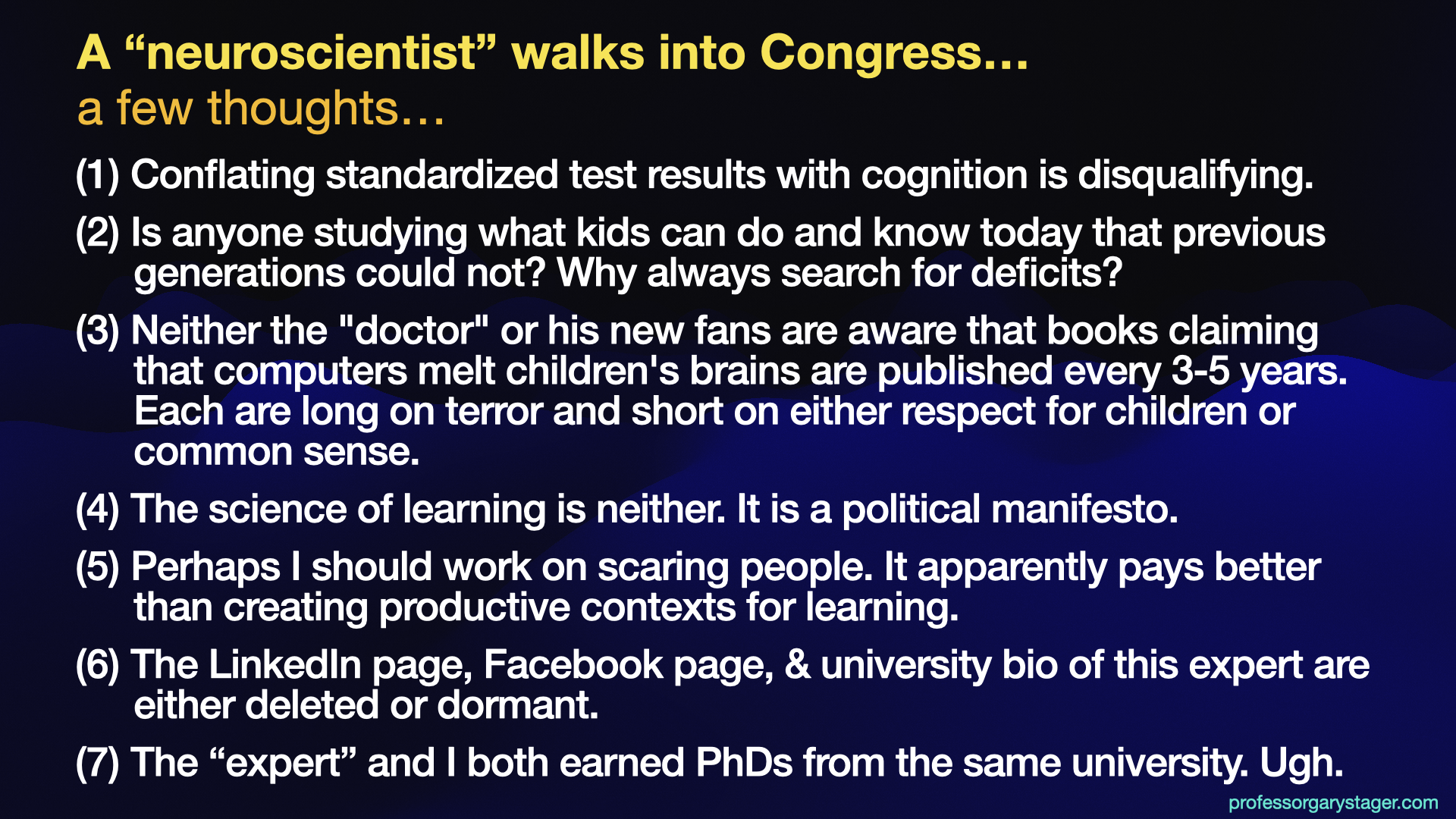
This is not the first time Congress has entered the fray, but the most recent hearing has gone viral due to a “neuroscientist” cosplaying as a doctor and comparing computers in a classroom to anthrax. That statement is disqualifying. I will not include a link because this nonsense does not deserve greater attention.
As I wrote decades ago, the folks setting federal education policy, are rarely the best or brightest among us. In the video below, Seymour Papert and Alan Kay testified before a Congressional committee comprised of literal felons and kooks. Watch the video and read the transcript of their fearless and optimistic testimony here. (Papert and Kay are worthy of your time. The others offer comic relief.)
Educator Responsibility
Educators are under no obligation to host speakers or share their notions, just because they are hot or popular, especially when doing so will undermine the mission, philosophy, and best practices of their school! Not ever no-show business school professor should be welcome to set pedagogical policy or terrify parents. There is no balance with quackery. Have some pride!
I genuinely don’t understand how or why school leaders would welcome a speaker or book sure to undermine their mission. This is not balance, but irresponsible masochism. Chaos, fear, and paralysis are educational kryptonite. Not succumbing to a fad may be the most productive act of leadership.
At the very least, educational leaders have a responsibility to check the credentials of the latest expert du jour. Let the school down the street waste their time and treasure on the latest source of hysteria.
We have a choice in what we read, share, and who we hire. Our responsibilities also include the simplest awareness of history and a modicum of skepticism. Cynical critics have long profited from attacking schools, disrespecting children, and eschewing modernity.
Optimistic Options
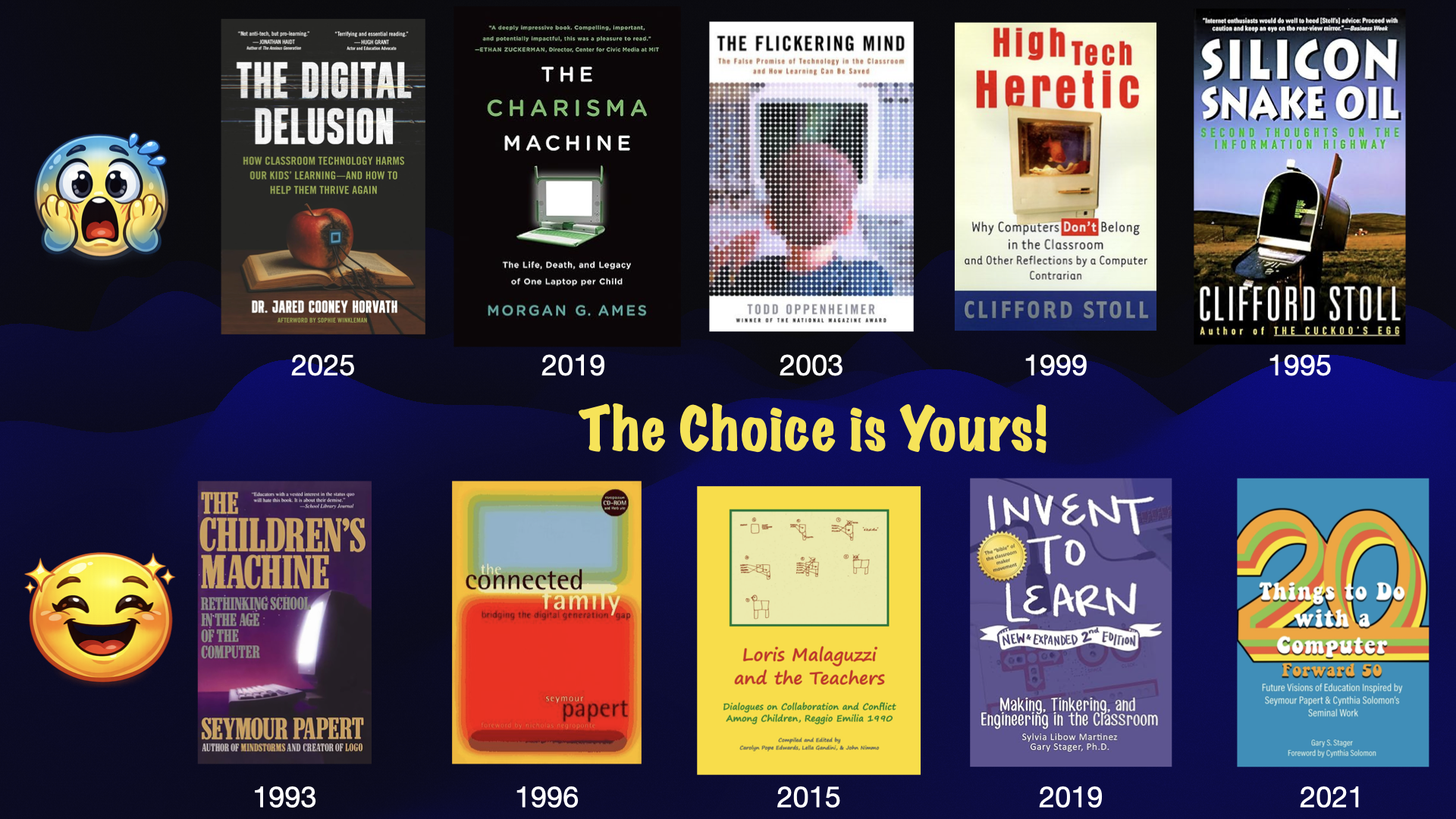
School communities interested in exploring the complex intersection of children, computers, and powerful ideas would be well advised to consider some of the following books.
- The Children’s Machine: Rethinking School in the Age of the Computer – Seymour Papert’s masterpiece on modern learning and teaching
- The Connected Family: Bridging the Digital Generation Gap – Papert’s book for parents interested in learning with their children
- Loris Malaguzzi and the Teachers – The father of the Reggio Emilia Approach investigates with teachers the thinking of young children programming computers
- Invent To Learn – Making Tinkering and Engineering in the Classroom – Considered the bible of the maker movement in schools, our book offers a creative vision of all sorts of materials in the classroom and the value of project-based learning
- Twenty Things to Do with a Computer – Forward 50 – Four dozen experts from around the world share constructive visions of knowledge construction with computers
- The Learner’s Apprentice: AI and the Amplification of Human Creativity – An expert at the intersection of children, computing, and learning shares humane and create ways in which artificial intelligence may be harnessed by learners
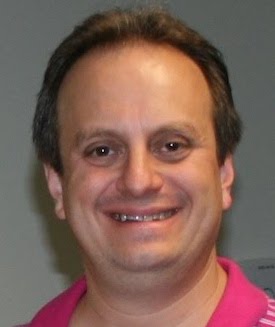
Veteran educator Gary Stager, Ph.D. is the author of Twenty Things to Do with a Computer – Forward 50, co-author of Invent To Learn — Making, Tinkering, and Engineering in the Classroom, publisher at Constructing Modern Knowledge Press, and the founder of the Constructing Modern Knowledge summer institute. He led professional development in the world’s first 1:1 laptop schools thirty years ago and designed one of the oldest online graduate school programs. Gary is also the curator of The Seymour Papert archives at DailyPapert.com. Learn more about Gary here.