 by
by At least 1,500 times a day I read something on LinkedIn that enrages me. (good news for the algorithm) A major source of ire comes from educators declaring an epiphany about how one might improve schools. My outrage stems from the banality of these humble brags signifying sudden clarity or insight.
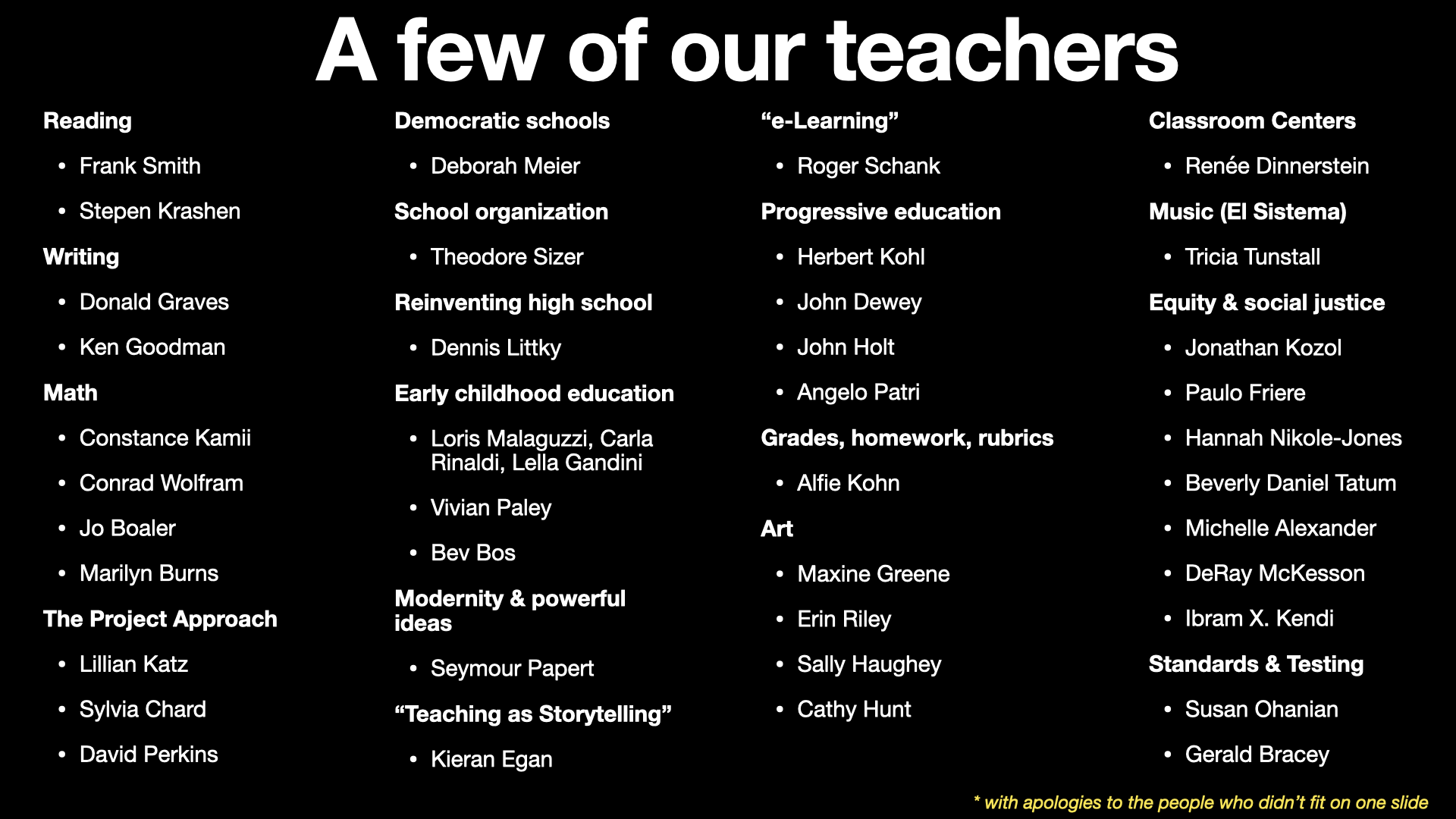
More often than not, my first thought is, “How is it possible that they are just discovering this when John Dewey, Seymour Papert, Deborah Meier, Carla Rinaldi, Loris Malaguzzi, Rabindranath Tagore, Eleanor Duckworth, Linda Darling-Hammond, Bev Bos, Herb Kohl, Jonathan Kozol, John Goodlad, A.S. Neill, Neil Postman, Maria Montessori, Plato, Angelo Patri, David Hawkins, Lillian Weber, Chris Lehmann, and countless others did/wrote/said/taught us that already – often with great fanfare?” Many of the “new” ideas you unearthed should have been covered in your first teacher education class.
However, my anger, frustration, and chagrin were tempered by a sudden realization of my own. In fact, the repeated “discovery” of what already exists is validation of a theory central to my life’s work. Perhaps the umpteenth “why don’t schools do X?” posts should not be seen as a demonstration of ignorance, but evidence of learning.
My educational praxis is framed by the Piagetian notion that “knowledge is a consequence of experience” and Seymour Papert’s theory of constructionism — that learning is best realized through the act of a learner making something sharable, not as a result of being taught.
A colleague’s sudden discovery of readily available knowledge proves the fallibility of instruction, not just weak or poor instruction, but all instruction. Schools and society-at-large overvalue instruction.
Jean Piaget had a fancy theoretical name for this phenomenon: genetic epistemology. A simple definition is that all knowledge is constructed, reconstructed, reinvented — learned — by the learner. Genetic epistemology explains how otherwise intelligent educators can suddenly realize that students need more play, or discover the value of project-based learning and arts education, or recognize the deleterious effects of grades, bells, age segregation, early start times, and so on.
Personal exasperation with such overdue “discoveries” is not unlike a teacher’s frustration that “We teach them, and we teach them, and we teach them, but they don’t stay taught.” You can lead a horse to water, but you can’t make it drink. Indeed.
Genetic epistemology explains why you can lead a school principal to a TED Talk, but they still run their school the same old way.
Perhaps the lingering question is, given that nearly every problem in education has been solved somewhere and often well documented, why is it that the system does not seem to get smarter, or evolve?
I’ll conclude by dispensing a bit of wisdom that you will likely ignore until you invent it yourself — “Less us, more them!” Whenever an educator or parent feels the need to intervene in a teachable moment, it is worth asking the question, “Is there less that I can do and more that they can do?” That shift in agency to the learner increases the likelihood of learning.
Extending grace to even the most shameless, click-chasing, chin-scratching social media oracles baring their vulnerability by pondering great educational mysteries solved long ago not only is a form of tolerance but should also serve as a reminder to them that while an educator can improve the conditions for learning, it is the learner who learns — and at their own pace.

Veteran educator Gary Stager, Ph.D. is the author of Twenty Things to Do with a Computer – Forward 50, co-author of Invent To Learn — Making, Tinkering, and Engineering in the Classroom, publisher at Constructing Modern Knowledge Press, and the founder of the Constructing Modern Knowledge summer institute. He led professional development in the world’s first 1:1 laptop schools thirty years ago and designed one of the oldest online graduate school programs. Gary is also the curator of The Seymour Papert archives at DailyPapert.com. Learn more about Gary here.