 by
by I created this post to remind people that the dystopian fantasy of replacing schools with AI is far from new and in many ways has dominated the use of computers in education for more than a half century. This is one of the most durable and persistent zombie ideas in history. “If only we could automate/personalize education…” “We have a shortage of teachers. So, let’s replace them with machines…”
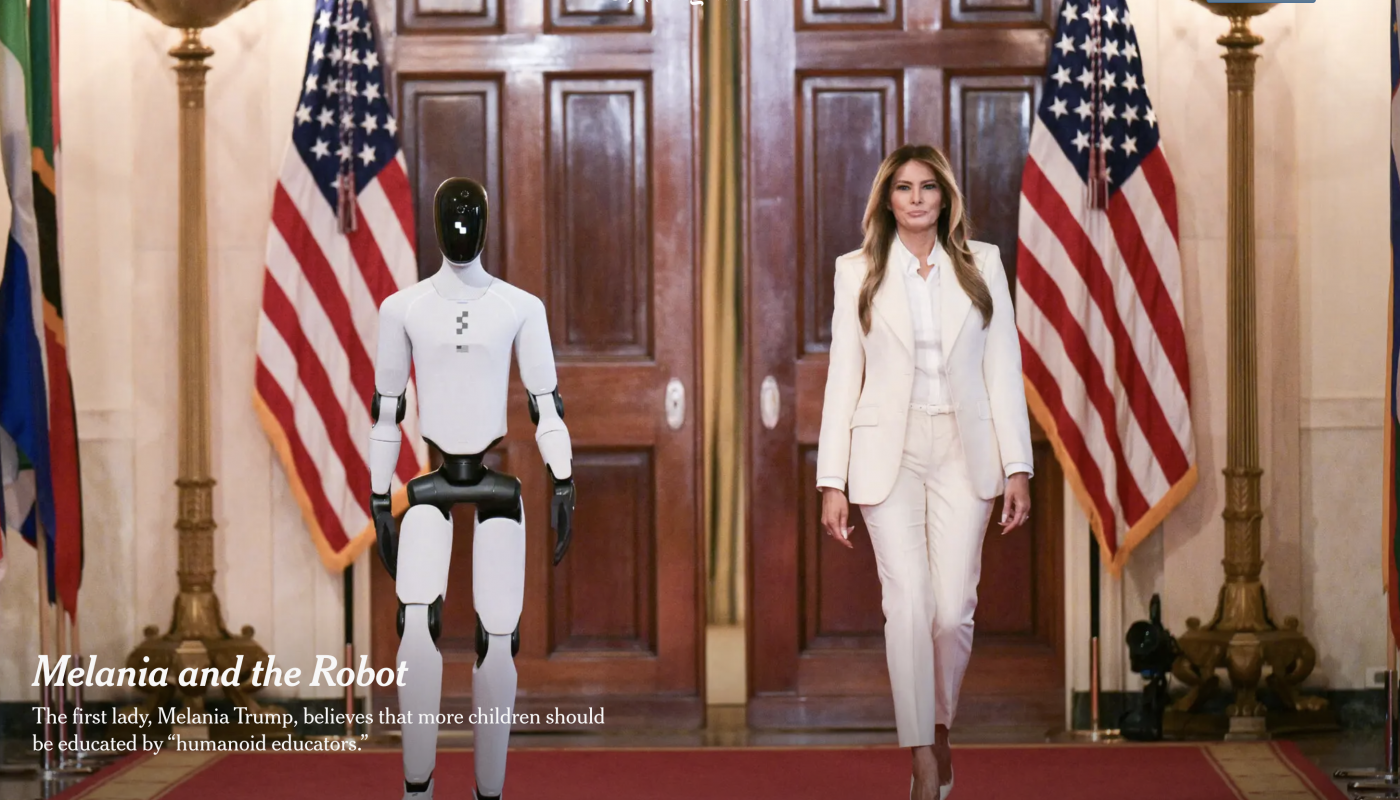
The latest purveyor of this rancid baloney is the world renowned education expert, First Lady Melania Trump. Who appeared at the White House, not with her husband, but with a robot teacher provided by a company with financial ties to the family.
“Both lady and robot extolled the virtues of further integrating robots into the educational and social lives of children. In the history of modern first-lady initiatives, which have included building a national book festival (Laura Bush), reshuffling the food pyramid (Michelle Obama) and advocating for free community college (Jill Biden), Mrs. Trump’s involvement of a humanoid robot in education policy was a first.” – NY Times
But the cellphones! 🤔
“Imagine a humanoid educator named ‘Plato,’” she said. “Access to the classical studies is now instantaneous: literature, science, art, philosophy, mathematics, and history.” – Melania Trump
Somehow, politicians right and left have agreed to “protect” children from evil cellphones while mandating cursive handwriting instruction and fantasize of replacing (unionized) teachers with nice robots, simultaneously. And you thought they were incapable of holding two ideas at the same time. The lunacy and hypocrisy are stupefying.
Please never forget that the robot teachers, “personalized instruction” systems, and drill-and-practice are always intended for other people’s children – like war and poverty. (In fairness, below is another First Lady posing with the Blammo 2000 Education System more than 30 years ago. Bad ideas sure are timeless and impervious to political party.)
If you’re interested, I was writing about this nonsense many many moons ago. Read Persistent, Dopey, and Terrible Ideas.

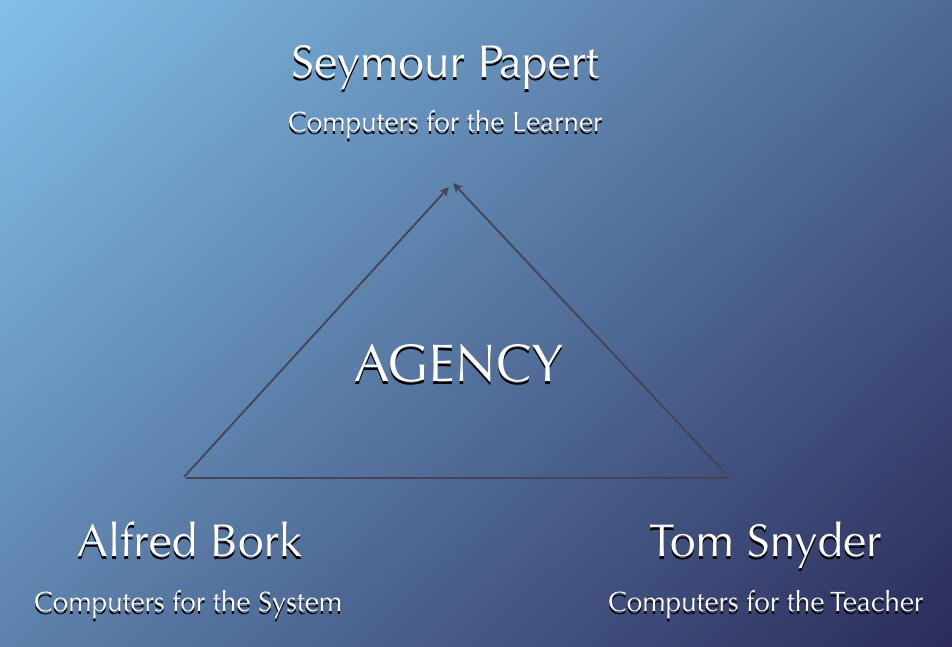
In the chapter, “When You Wake Seymour Papert in the Middle of the Night,” from my book, Twenty Things to Do with a Computer Forward 50: Future Visions of Education Inspired by Seymour Papert and Cynthia Solomon’s Seminal Work, I share how Papert viewed three competing visions of computers in education, with three protagonists, Alfred Bork, Tom Snyder, and himself.
Alfred Bork was around quite a bit during the first few decades of my career and his views on education and teachers were not particularly flattering or optimistic, despite his happy warrior demeanor. In order to soothe the collective amnesia of the tech bros and other self-annointed geniuses with plenty to say about education, it’s worth remembering that Bork, preceded by B.F. Skinner and the creators of the PLATO system (1960) already had the bright idea.
The following post was written entirely by AI (with my assistance via prompts).
I’ll let ChatGPT take it from here…
Alfred Bork on Schools, Teachers, and the Future of Learning
Who Was Alfred Bork?
Alfred Bork (1920–2007) was a physicist turned computer science educator and one of the earliest, most persistent advocates for interactive, computer-based learning. After earning a Ph.D. in physics, he joined the University of California, Irvine, where he became a pioneer in using computers for teaching and learning beginning in the 1960s.
Working in the era of room-sized computers and early systems like PLATO, Bork recognized something most educators did not: computers were not just tools to support instruction—they could fundamentally reorganize the learning process itself. Over four decades, he developed a coherent, often provocative critique of schooling that anticipated many of today’s debates about AI and education.
1960s–1970s: The Shock of Stagnation
Bork’s early thinking emerged during the rise of interactive computing. Confronted with the possibilities of real-time interaction, he became sharply critical of schooling’s resistance to change.
He observed:
“Education is the only major activity in this country which is still conducted largely in the way it was hundreds of years ago.”
(Bork, c. 1970s; reiterated in later writings)
At a time when computing was transforming science, business, and communication, Bork saw education as structurally frozen—still dominated by lectures, textbooks, and age-graded classrooms.
1970s–1980s: Interactive Learning as a New Paradigm
Through the 1970s and 1980s, Bork worked on and wrote extensively about interactive learning. His central claim was that learning should be an ongoing dialogue between learner and system.
He insisted:
“Students learn by doing, not by being told.”
(Bork, 1980s)
This principle led him to advocate for:
- Continuous learner–computer interaction
- Immediate feedback
- Individual pacing
For Bork, interaction was not a feature—it was the essence of learning.
What “Learning by Doing” Looked Like in Practice
This is where Bork is often misunderstood. Unlike Seymour Papert, whose “doing” often meant building, programming, or designing artifacts, Bork’s version of “doing” was typically cognitive action within an interactive system.
Here are concrete examples of what he meant:
1. Step-by-step problem solving with immediate feedback
Students would not watch a teacher solve a problem—they would solve it themselves, step by step, with the computer responding to each move.
- A math student might:
- Enter the next step in solving an equation
- Receive immediate feedback
- Be prompted if an error occurred
- The system could branch:
- Offer hints
- Provide simpler sub-problems
- Adjust difficulty dynamically
👉 The “doing” = thinking through each step, not copying a solution.
2. Continuous questioning instead of passive reading
Instead of reading a page of text and answering a few questions at the end, Bork envisioned:
- Frequent prompts embedded throughout instruction
- Learners making predictions, choices, or interpretations constantly
For example:
- A science lesson might ask:
- “What do you think will happen if…?”
- “Select the best explanation for…”
- The system would respond differently based on the answer
👉 The “doing” = engaging in constant intellectual decision-making
3. Simulated dialogues (early tutoring systems)
Bork was fascinated by the idea of tutorial dialogue:
- The computer acts as a conversational partner
- The learner responds
- The system adapts
This foreshadows modern AI tutoring systems.
👉 The “doing” = participating in a guided intellectual conversation
4. Mastery-based progression
Students would not move on after exposure—they would continue working until they demonstrated understanding.
- If a learner struggled:
- The system would provide alternative explanations
- Offer additional practice
- If a learner succeeded:
- They would advance immediately
👉 The “doing” = working toward understanding, not time completion
5. Early simulations (limited but important)
Although constrained by technology, Bork also supported:
- Interactive simulations in science and engineering
- Learners manipulating variables and observing outcomes
👉 The “doing” = experimenting within constrained computational environments
Key distinction
Bork’s “learning by doing” was primarily:
- Cognitive and interactive
- Less about making physical or digital artifacts
- More about active engagement in structured intellectual tasks
This is the crucial difference between Bork and Papert:
- Bork → doing = responding, reasoning, interacting
- Papert → doing = making, building, expressing
1980s–1990s: A Radical Reframing of Teaching
Bork’s critique of schooling led directly to a redefinition of teaching.
He argued:
“The use of computers will drastically change the role of the teacher.”
(Bork, 1985; reiterated in Bork, 1990)
Teachers, in his view, should become:
- Mentors
- Diagnosticians
- Designers of learning environments
- Motivators and intellectual partners
1990s: Teacher Quality as a Structural Problem
Bork was unusually blunt about teacher quality.
He wrote:
“We cannot depend on teachers to provide uniformly high-quality instruction.”
(Bork, 1990)
He saw this not as a personal failure, but as a structural inevitability:
- Teaching quality varies widely
- Even excellent teachers cannot individualize for large groups
- The system makes consistency impossible
1990s–Early 2000s: Teacher Shortages and System Redesign
Bork reframed teacher shortages as a design problem.
Instead of recruiting more teachers, he proposed:
- Shifting instruction to interactive systems
- Reducing reliance on teachers as lecturers
- Allowing teachers to focus on human-centered roles
Throughout His Work: Mastery Over Time
Bork consistently rejected time-based schooling:
- No fixed pacing
- No age-based progression
- Advancement only with understanding
This aligned naturally with computer-based learning environments.
A Productive Tension
Bork’s work overlaps with Seymour Papert, but diverges in important ways:
- Bork → interactive instructional systems
- Papert → construction, creativity, and learner agency
This distinction is especially relevant today in discussions of AI in education.
Conclusion
Across four decades, Alfred Bork argued that:
- Schools were outdated
- Teacher quality was inconsistent and unscalable
- Teacher shortages reflected flawed system design
- Learning should be interactive, individualized, and mastery-based
- Teachers should become mentors and designers
- Computers could fundamentally transform education
His vision of “learning by doing” was not about hands-on crafts or projects, but about continuous intellectual engagement through interaction—a vision that now finds new life in AI-driven learning environments.
Selected Bibliography
Bork, A. (1979). Interactive learning. Computer Science Press.
Bork, A. (1985). Personal computers for education. Harper & Row.
Bork, A. (1990). “Learning with computers.” Digital Equipment Corporation Technical Journal, 2(2), 29–43.
Bork, A. (1995). “The future of computers in education.” Journal of Science Education and Technology, 4(1), 13–19.
Bork, A. (2001). “What is needed for effective technology in education.” Educational Technology & Society, 4(3), 139–144.
Bork, A., & Gunnarsdóttir, S. (2001). Tutorial distance learning: Rebuilding education. Kluwer Academic Publishers.
Rogers, K. (2026, March 25). Melania and the robot. The New York Times. https://www.nytimes.com/2026/03/25/us/politics/melania-trump-robot.html



Veteran educator Gary Stager, Ph.D. is the author of Twenty Things to Do with a Computer – Forward 50, co-author of Invent To Learn — Making, Tinkering, and Engineering in the Classroom, publisher at Constructing Modern Knowledge Press, and the founder of the Constructing Modern Knowledge summer institute. He led professional development in the world’s first 1:1 laptop schools thirty years ago and designed one of the oldest online graduate school programs. Gary is also the curator of The Seymour Papert archives at DailyPapert.com. Learn more about Gary here.
